Blogmaster's Note: There's a lot of work being done this spring on the river to collect endangered pallid sturgeon for breeding and restocking and tracking gravid pallid sturgeon as they move upriver to spawn. The Missouri Dept. of Conservation, US Fish & Wildlife Service, South Dakota Game, Fish & Parks, Nebraska Game & Parks, US Geological Survey and US Army Corps of Engineers are all involved and partnering together on the projects.
Click here for the excellent blog by the US Geological Survey River Studies Branch on their Comprehensive Sturgeon Research Project:http://www.usgs.gov/blogs/csrp/
Below is a reprint of an article published by Bill Graham of the Missouri Dept. of Conservation.
Primitive fish a precious catch to save the species
By Bill Graham, MDC.
A pallid sturgeon born in the muddy flows of the Missouri or Mississippi rivers and surviving more than a decade to reach reproductive maturity is among the rarest fishes in North America, an endangered species facing extinction.
Which is why a researcher who nonchalantly handles dozens of big fish daily got excited when he saw the flat snout and staggered barbels on a pale, three-foot-long fish thrashing in the Missouri River.
“Ooh, big pallid,” shouted Thomas Huffmon, a resource science assistant for the Missouri Department of Conservation seeking hatchery brood fish to save a species.
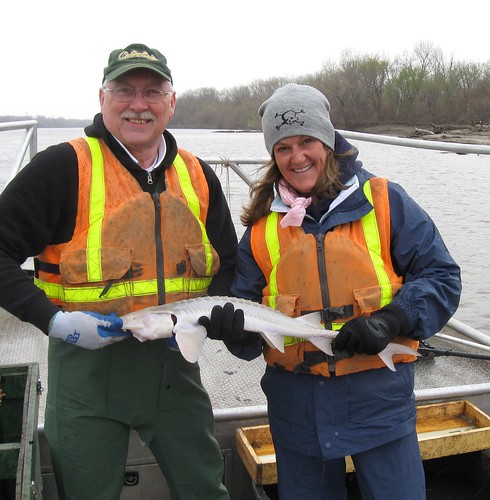
Right: Missouri River Relief's Vicki Richmond and Missouri Master Naturalist Mark Chambers show off a hatchery pallid sturgeon they helped catch with Thomas Huffmon's MDC crew this spring.
Boat operator Darby Niswonger quickly shifted the motor to idle and prepared to help land the prehistoric fish.
Showing posts with label US Geological Survey. Show all posts
Tuesday, April 26, 2011
Scientists write about their pallid sturgeon work
Wednesday, April 6, 2011
Funds sought for river gauges
Originally published on April 6, 2011 in the Omaha World-Herald
Click here for original link.
By Nancy Gaarder
Blogmaster's Note: These cuts are not restricted to Nebraska and Iowa, but include Missouri and Kansas as well. There is a meeting in Council Bluffs about the proposed cuts: Thursday, 1 p.m. to 4 p.m., Iowa National Guard Armory, 2415 E. Kanesville Blvd., Council Bluffs
The number of Missouri River gauges in Nebraska and Iowa could be reduced under an Obama administration budget proposal.
The gauges are important to such things as flood forecasting, electric power generation and municipal water supplies.
But because so few barges ply the Missouri River, the gauges aren't as important to their original purpose — navigation. This is why some are at risk of being shut down.
To avoid that possibility, the two federal agencies responsible for the gauges are appealing to communities, states, utilities and others to consider setting aside money to cover any lost federal dollars.
The Army Corps of Engineers and U.S. Geological Survey will host a public meeting Thursday in Council Bluffs to discuss the river gauges.
“We want to lay it all on the line and say, ‘Here's what we're looking at,' so that they have more time to see if they can scrape up the funding,” said Greg Nalley, data chief for the U.S. Geological Survey in Iowa.
Nalley said the Geological Survey and Corps of Engineers have a history of working with local governments on funding for gauges. Each gauge costs about $14,900 a year to operate, he said.
That hasn't kept all gauges operating, however. Nalley said Iowa has 18 gauges along the Missouri River and its tributaries, but at one time had about 26.
Tim Temeyer of the Corps of Engineers in Omaha said the gauges are funded through a portion of the Corps budget that pays for bank stabilization and navigation on the Missouri River.
Temeyer, chief of the water control and water quality section of the Omaha corps, said the agency is proposing to set priorities by making cuts based on a program's purpose.
Because the Missouri River sees relatively few barges, proportionately more gauges would be cut along the Missouri River than along a river with significant barge travel, such as the Mississippi or Ohio.
Like Nalley, Temeyer said the goal of the Thursday meeting is to get ahead of any potential cuts.
As it stands now, no one knows what will happen with next year's federal budget, he said. However, the budget year starts in October, so it's possible that funding for gauges could be lost as early as this fall.
As currently proposed, the Missouri River program could see a 40 percent cut, said Dick Taylor, operations program manager for the corps.
The cuts would also affect gauges in the State of Missouri.
Bob Swanson, director of the Geological Survey's Nebraska Water Science Center, said the gauges are important on both sides of the river.
“As these gauges get dropped, they're very hard to replace,” he said.
Swanson said he is hopeful that others agencies will step up.
Click here for original link.
By Nancy Gaarder
Blogmaster's Note: These cuts are not restricted to Nebraska and Iowa, but include Missouri and Kansas as well. There is a meeting in Council Bluffs about the proposed cuts: Thursday, 1 p.m. to 4 p.m., Iowa National Guard Armory, 2415 E. Kanesville Blvd., Council Bluffs
The gauges are important to such things as flood forecasting, electric power generation and municipal water supplies.
But because so few barges ply the Missouri River, the gauges aren't as important to their original purpose — navigation. This is why some are at risk of being shut down.
To avoid that possibility, the two federal agencies responsible for the gauges are appealing to communities, states, utilities and others to consider setting aside money to cover any lost federal dollars.
The Army Corps of Engineers and U.S. Geological Survey will host a public meeting Thursday in Council Bluffs to discuss the river gauges.
“We want to lay it all on the line and say, ‘Here's what we're looking at,' so that they have more time to see if they can scrape up the funding,” said Greg Nalley, data chief for the U.S. Geological Survey in Iowa.
Nalley said the Geological Survey and Corps of Engineers have a history of working with local governments on funding for gauges. Each gauge costs about $14,900 a year to operate, he said.
That hasn't kept all gauges operating, however. Nalley said Iowa has 18 gauges along the Missouri River and its tributaries, but at one time had about 26.
Tim Temeyer of the Corps of Engineers in Omaha said the gauges are funded through a portion of the Corps budget that pays for bank stabilization and navigation on the Missouri River.
Temeyer, chief of the water control and water quality section of the Omaha corps, said the agency is proposing to set priorities by making cuts based on a program's purpose.
Because the Missouri River sees relatively few barges, proportionately more gauges would be cut along the Missouri River than along a river with significant barge travel, such as the Mississippi or Ohio.
Like Nalley, Temeyer said the goal of the Thursday meeting is to get ahead of any potential cuts.
As it stands now, no one knows what will happen with next year's federal budget, he said. However, the budget year starts in October, so it's possible that funding for gauges could be lost as early as this fall.
As currently proposed, the Missouri River program could see a 40 percent cut, said Dick Taylor, operations program manager for the corps.
The cuts would also affect gauges in the State of Missouri.
Bob Swanson, director of the Geological Survey's Nebraska Water Science Center, said the gauges are important on both sides of the river.
“As these gauges get dropped, they're very hard to replace,” he said.
Swanson said he is hopeful that others agencies will step up.
Tuesday, March 15, 2011
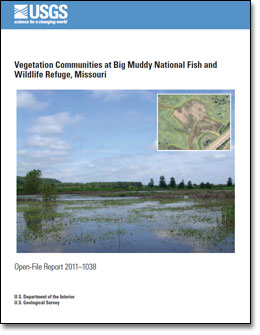
The Vegetation Communities of the Big Muddy National Fish & Wildlife Refuge

Here's a link to the just released report from the US Geological Survey on the vegetational communities of the Big Muddy National Fish and Wildlife Refuge. http://pubs.usgs.gov/of/2011/1038/
The study covers plots in the Jameson Island, Lisbon Bottoms, Overton Bottoms, St. Aubert's Island and Boone Crossing Units of the refuge along the Missouri River. The report compiles data collected during bird and aerial photography studies in 2002-07 with a more complete vegetation dataset collected in 2009.
The study was completed by Matthew Struckoff, Keith Grabner and Esther Stroh of USGS and published in March, 2011.
Some interesting stuff follows the dynamic changes in young cottonwood and willow forests as they mature following their establishment after the 1993 flood, when many areas of the refuge were taken out of agriculture. As the refuge has grown, some flood protection has been removed allowing for substantial annual flooding. This flooding, in just the past few years, has drastically changed some of the "old field" communities into dynamic and diverse ephemeral wetlands and wet prairies. Cool stuff.
Here's the link to the USGS announcement. From there you can download the report and the detailed appendices.
http://pubs.usgs.gov/of/2011/1038/
Thursday, December 16, 2010
Columbia researchers study intersex sturgeon in Missouri River
(this article was published in the Dec. 6 edition of the Columbia Missourian. Here's the direct link, which contains great photos, background and action info not copied here: http://www.columbiamissourian.com/stories/2010/12/06/columbia-researchers-find-intersex-sturgeon-missouri-river/)
Monday, December 6, 2010 | 10:38 p.m. CST; updated 11:54 a.m. CST, Tuesday, December 7, 2010
BY Katy Bergen
COLUMBIA — Donald Tillitt was in his office at the Columbia Environmental Research Center when he received a call.
“You need to come back here and look at these,” Tillitt recalls biologist and colleague Diana Papoulias saying.
The year was 2000 and the U.S. Geological Survey research center on New Haven Road was dissecting shovelnose sturgeon from a site south of Columbia in the Missouri River. By studying the reproduction of the species, scientists hoped they could shed light on decreasing populations of a similar but endangered species — the pallid sturgeon.
When Tillitt looked inside the fish before him he saw ovarian tissue — black eggs — growing around white testicular tissue. It had the fully developed sex organs of both a male and a female sturgeon.
Monday, December 6, 2010 | 10:38 p.m. CST; updated 11:54 a.m. CST, Tuesday, December 7, 2010
BY Katy Bergen
COLUMBIA — Donald Tillitt was in his office at the Columbia Environmental Research Center when he received a call.
“You need to come back here and look at these,” Tillitt recalls biologist and colleague Diana Papoulias saying.
The year was 2000 and the U.S. Geological Survey research center on New Haven Road was dissecting shovelnose sturgeon from a site south of Columbia in the Missouri River. By studying the reproduction of the species, scientists hoped they could shed light on decreasing populations of a similar but endangered species — the pallid sturgeon.
When Tillitt looked inside the fish before him he saw ovarian tissue — black eggs — growing around white testicular tissue. It had the fully developed sex organs of both a male and a female sturgeon.
Subscribe to:
Posts (Atom)